
What is the Difference between Forest Bathing and Forest Therapy?
by Julie Sczerbinski
If you’ve been exploring nature-based wellness practices, you’ve likely come across the terms forest bathing and forest therapy. They are closely related, and sometimes used interchangeably, which can make the difference between them a little confusing.
In fact, forest bathing is technically a modality of forest therapy, though in everyday conversation the two terms are often used to describe the same experience. For example, when mainstream media publishes articles about forest bathing, they are often describing forest therapy experiences that involve being guided by Certified Forest Therapy Guides.
To understand the roots of the practice, it helps to return to the Japanese term Shinrin-yoku, where the concept originated. Dr. Qing Li, one of the world’s foremost experts in forest medicine, explains it this way in his article, New Concepts of Forest Medicine:
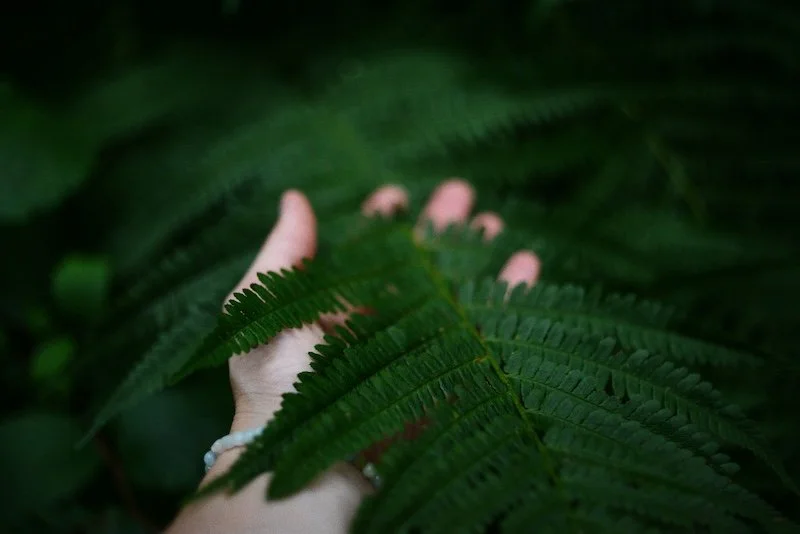
“Shinrin-yoku is translated into forest bathing in English. Shinrin in Japanese means ‘forest’, and yoku means ‘bath’. Therefore, Shinrin-yoku means bathing in a forest atmosphere or taking in the forest through our senses. This is not exercise, i.e., hiking or jogging. It is simply being in nature, connecting with it through our senses of sight, hearing, taste, smell, and touch. Shinrin-yoku is like a bridge. By opening our senses, it bridges the gap between us and the natural world.”
At its heart, forest bathing is the practice of slowing down in a forest and engaging the senses. It is not hiking, naturalist education, or exercise. Instead, it invites a gentle, attentive presence with the natural world.
Forest therapy grew from this foundation. It is often a guided experience, where a trained guide helps participants enter into a deeper relationship with the land. So, in other words, forest therapy is the container in which a guide intentionally supports and nurtures the forest bathing experience.
Dr. Qing Li explains:
“Forest Therapy was developed from forest bathing (Shinrin-yoku), which is a research-based healing practice that involves immersing oneself in forest environments with the aim of improving mental and physical health as well as disease prevention while at the same time being able to enjoy and appreciate the forest environment. Forest therapy is defined as a proven Shinrin-yoku effect.”
At Heartwood, we describe forest therapy as a guided nature-based practice that invites a slow, sensory immersion in forests and other natural landscapes to support mental, physical, emotional, and relational well-being.
During a guided forest therapy walk, a Certified Forest Therapy Guide holds the space for the experience to unfold. Through carefully crafted invitations, the guide supports participants in moving from thinking about Nature to direct, felt relationship with the living world around them. These invitations are not instructions, but gentle suggestions that encourage curiosity, presence, and sensory awareness.
While both forest bathing and forest therapy offer meaningful health benefits, they arise in slightly different ways. Some benefits come simply from being in a forest environment, such as reduced stress, improved mood, and support for overall wellbeing. Other benefits can emerge from how we are invited to be with the forest. A skilled guide helps create conditions that deepen sensory awareness, connection, and relational experience with the more-than-human world.
Another important aspect of forest therapy is that it supports a shift in perspective. Rather than seeing Nature only as a resource to use or a backdrop for recreation, the practice invites us to remember the forest as something we are part of. Over time, this can help move us from viewing nature as a resource to experiencing it as home.
Whether practiced alone or in a guided experience, forest bathing and forest therapy both offer pathways back to connection with the natural world and with ourselves.
For those who feel called to share this work with others, Heartwood School of Forest Therapy offers a Forest Therapy Guide Certification Program that prepares guides to facilitate these experiences with care, presence, and respect for both people and the land. Through a mindfulness and somatic-based approach, participants learn how to create meaningful opportunities for connection between humans and the more-than-human world.
Because when we slow down, listen with our senses, and enter into relationship with the natural world, the forest is no longer a place we visit. The forest becomes a landscape we belong to.