
If you’ve been exploring nature-based wellness practices, you’ve likely come across the terms forest bathing and forest therapy. They are closely related, and the terms are sometimes used interchangeably, which can make the difference between them a little confusing.
So, is forest bathing the same as forest therapy?
The short answer is that they share the same roots, but there are some differences in how the practices are understood and experienced.
Forest bathing is the practice of slowing down and experiencing the forest through the senses. Forest therapy grew from this foundation and is often a guided experience in which a trained guide intentionally supports participants in deepening their sensory awareness, connection with the land, and relationship with the natural world.
To better understand the difference, it helps to begin with where the practice originated.
What Is Forest Bathing?
Forest bathing comes from the Japanese practice of Shinrin-yoku, which emerged in Japan in the 1980s. Shinrin means forest and yoku means bath. Together, the words describe the experience of “bathing in the atmosphere of the forest.”
There is no actual bathing involved.
Instead, forest bathing invites us to slow down and take in the forest through our senses.
We might notice sunlight moving through the leaves, listen to birds calling nearby, feel the texture of bark beneath our fingertips, breathe in the scent of the forest, or simply sit somewhere and notice what is happening around us.
This is different from many of the ways we typically spend time outdoors. When we hike, we often have a destination or a certain number of miles we want to cover. When we exercise outdoors, we may be focused on speed, distance, or physical effort. A nature walk might be centered around identifying plants, birds, or other species.
Forest bathing doesn't require us to get anywhere or accomplish anything. Instead, we slow down enough to experience the place we are in through our senses in the present moment.
What Is Forest Therapy?
Forest therapy grew from the foundation of forest bathing.
At Heartwood, we describe forest therapy as a guided nature-based practice that invites a slow, sensory immersion in forests and other natural landscapes to support mental, physical, emotional, and relational wellbeing.
While forest bathing can easily be practiced on your own, forest therapy is often experienced with the support of a trained guide.
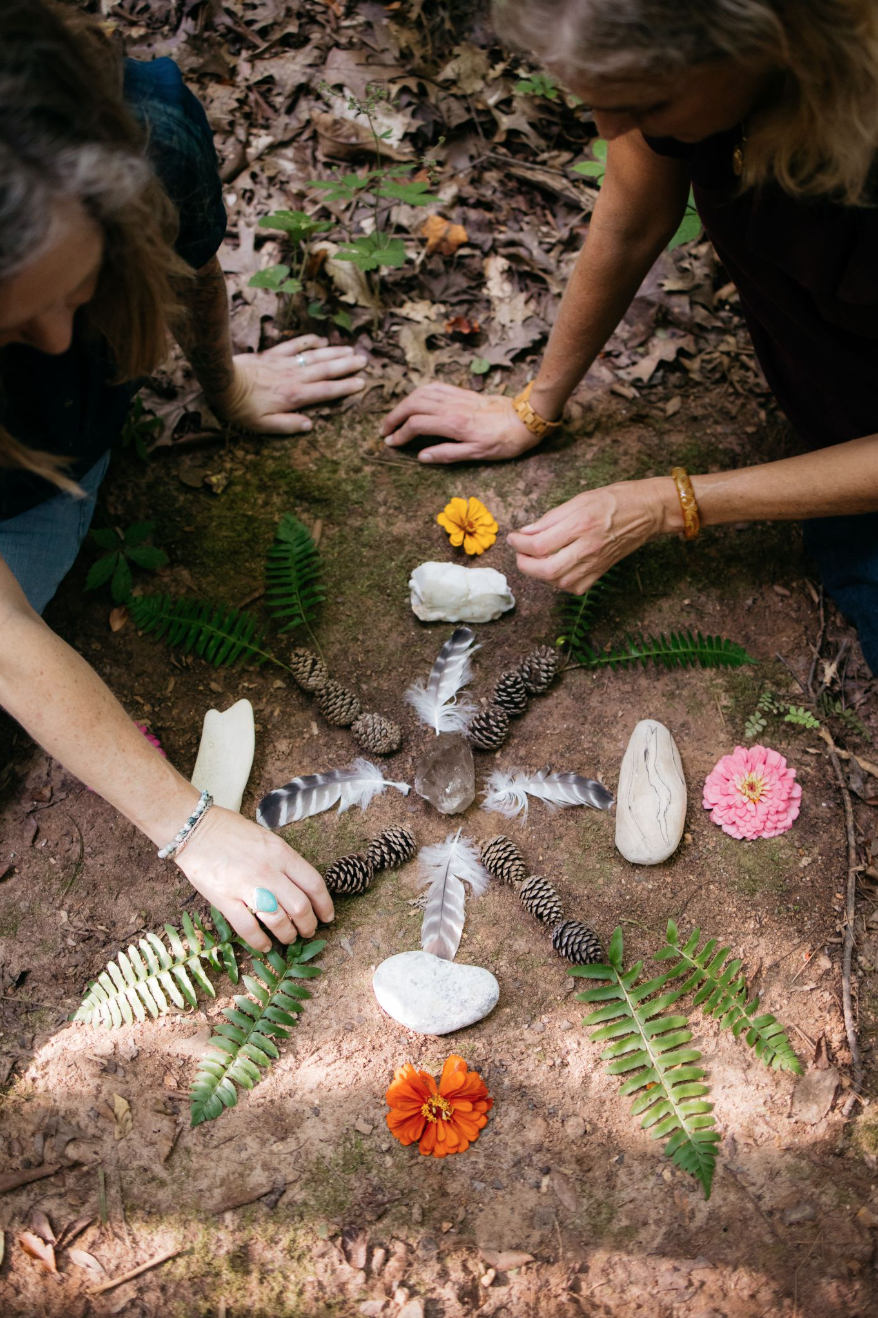
During a guided forest therapy session, a guide holds the space for the experience to unfold. Through a carefully designed experience, the guide supports participants in moving from thinking about Nature to a direct, felt relationship with the living world around them. In this way, forest therapy creates a container in which the forest bathing experience can deepen.
What Happens During a Guided Forest Therapy Experience?
A guided forest therapy session is usually quite different from a traditional hike or guided nature walk. Very little distance may be covered, and the pace is intentionally slow.
The experience often begins with a grounding or embodiment practice that helps participants arrive more fully in their bodies and in the landscape.
From there, the guide offers a series of invitations that create different opportunities for sensory exploration and connection with the land. These invitations are not instructions, but gentle suggestions that encourage curiosity, presence, and sensory awareness.
For example, a guide might invite participants to notice movement in the landscape, follow a sound, explore a place through touch, wander slowly, spend time with a tree, or simply notice what is drawing their attention. There is no right way to respond to an invitation. Each person is encouraged to follow their own curiosity and experience.
Participants may also come together periodically and have an opportunity to share something from their experience.
Throughout the session, the guide is paying attention to both the people and the place, including noticing what the land is offering, considering physical and emotional safety, and adapting the experience to the needs of the group.
The result is an experience that has structure while still leaving plenty of room for each person to have their own connection with the land.
Why Practice With a Forest Therapy Guide?
You don't need a guide to practice forest bathing. Anyone can slow down in a natural place, engage their senses, and spend time simply being present outdoors.
But a trained forest therapy guide can help us experience the natural world in ways we might not think to explore on our own.
Most of us are accustomed to moving quickly through our days. We're often focused on what needs to happen next, what needs to be accomplished, or what needs our attention. We can carry those same habits with us when we go outside.
A guide helps create the conditions for something different.
Through pacing, sensory invitations, grounding practices, opportunities for reflection, and an awareness of both people and place, the guide supports participants in becoming more present and receptive to their experience.
A well-trained forest therapy guide also brings an understanding of group facilitation, accessibility, trauma-informed practices, physical and emotional safety, and how to work in partnership with the landscape.
Rather than being the focus of the experience, the guide helps turn participants' attention toward their own bodies, their senses, and the living world around them.
The Benefits of Forest Bathing & Forest Therapy
One of the reasons forest bathing has gained so much attention is the growing body of research showing that time spent intentionally immersed in forest environments can support both physical and mental well-being.
Research on Shinrin-yoku began in Japan in the 1980s and eventually contributed to the emerging field of forest medicine. Since then, researchers have studied the benefits of forest bathing and what happens in the body and brain when people spend time in forests, and the findings help explain why we often feel different after time among the trees.
Studies have found that forest bathing may help lower cortisol levels, reduce blood pressure and heart rate, decrease stress and anxiety, and improve mood. Research has also found increased activity in the parasympathetic nervous system, the part of our nervous system associated with rest, recovery, and restoration.
There are benefits for the mind as well. Time in natural environments has been associated with improved attention and cognitive function, reduced mental fatigue, and greater feelings of well-being. Stepping away from screens, responsibilities, and the constant stream of information competing for our attention allows the mind to rest and recover.
Researchers have also explored the effects of forests on immune function. Trees release aromatic compounds called phytoncides, natural substances that help protect them from insects, bacteria, and disease. Research led by Dr. Qing Li found that exposure to forest environments and phytoncides was associated with increased activity of natural killer (NK) cells, an important part of the body's immune defense.
Forest bathing brings many of these supportive elements together. We breathe the forest air, move slowly, engage our senses, allow our attention to rest on the natural world, and give ourselves time away from the demands of everyday life.
And we don't necessarily need to spend an entire day in the forest to benefit from time in Nature. While a longer forest bathing experience gives us the opportunity to settle more deeply into the practice, even shorter periods of intentional Nature connection can offer a meaningful pause in the day.
The research is continuing to evolve, but it increasingly supports something many people recognize through their own experience: spending time in Nature is good for us, and the way we spend that time matters.
Forest Therapy as a Relational Practice
This relational aspect is an important part of how we approach forest therapy at Heartwood.
Nature is often viewed through the lens of what Nature can provide for us: recreation, resources, beauty, stress relief, or health benefits. Forest therapy invites us to widen that perspective and remember that we are participants in the natural world, not separate from it.
As we slow down during a session and pay attention, we begin to encounter the landscape differently. Instead of simply walking past a tree, we might spend time with the tree. We notice the tree’s shape, the texture of the bark, and the way the leaves respond to the wind.
This kind of attention can change the way we experience a place. We begin to recognize individual trees, notice seasonal changes, learn the rhythms of birds and other animals, and become aware of the many relationships unfolding around us. The landscape can even begin to feel familiar. We come to know the place, and in our own way, feel known by the land.
This sense of relationship also invites reciprocity. As our connection with a place deepens, we may begin to wonder what it means to care for the places that care for us. Reciprocity might be expressed through tending the land, learning about the ecosystem where we live, changing how we interact with the more-than-human world, or simply approaching Nature with greater respect and gratitude.
This is part of what makes forest therapy different from simply using Nature as a setting for wellness. The benefits we receive matter, but they are only part of the experience. The practice can also awaken a deeper awareness of belonging and our place within a much larger living community.
Over time, Nature can become more than somewhere we go to feel better. It can become a place of relationship and belonging, a place we experience as home.
Two Practices With Shared Roots
Forest bathing and forest therapy share the same foundation: slowing down, engaging the senses, and becoming more present with the natural world. The difference lies largely in how the experience is held. Forest bathing can be practiced on your own, while forest therapy often brings in the support of a trained guide who creates an intentional experience for deepening connection with the land, ourselves, and the living world around us.
Whichever way you enter the practice, there is something powerful in simply changing the way we spend time outdoors. When we stop moving through Nature with somewhere to go or something to accomplish, we begin to notice more, discover the life unfolding around us, and remember that we are part of that living web.
For some people, experiencing forest therapy awakens a desire to share the practice with others.
Becoming a Certified Forest Therapy Guide involves much more than leading a walk in the woods. Guides learn how to design and facilitate experiences, create meaningful invitations, work with groups, support accessibility, attend to physical and emotional safety, and develop a deeper relationship with the landscapes where they guide.
At Heartwood School of Forest Therapy, our Forest Therapy Guide Certification Program teaches these skills through a curriculum that weaves together mindfulness, somatic awareness, Earth-based wisdom, and trauma-informed facilitation.
Contact us today to learn more about our programs and how to become a certified forest therapy guide!