
What Are the Benefits of Forest Bathing & Why Is It Good for Your Health?
Have you ever stepped into a forest and felt your whole body exhale?
Maybe all you did was silence your phone and leave your to-do list behind. So what’s the magic behind crossing the threshold from the parking lot onto the trail that brings that long-awaited exhale and allows some of the tension in your body to release?
Welcome to forest bathing!
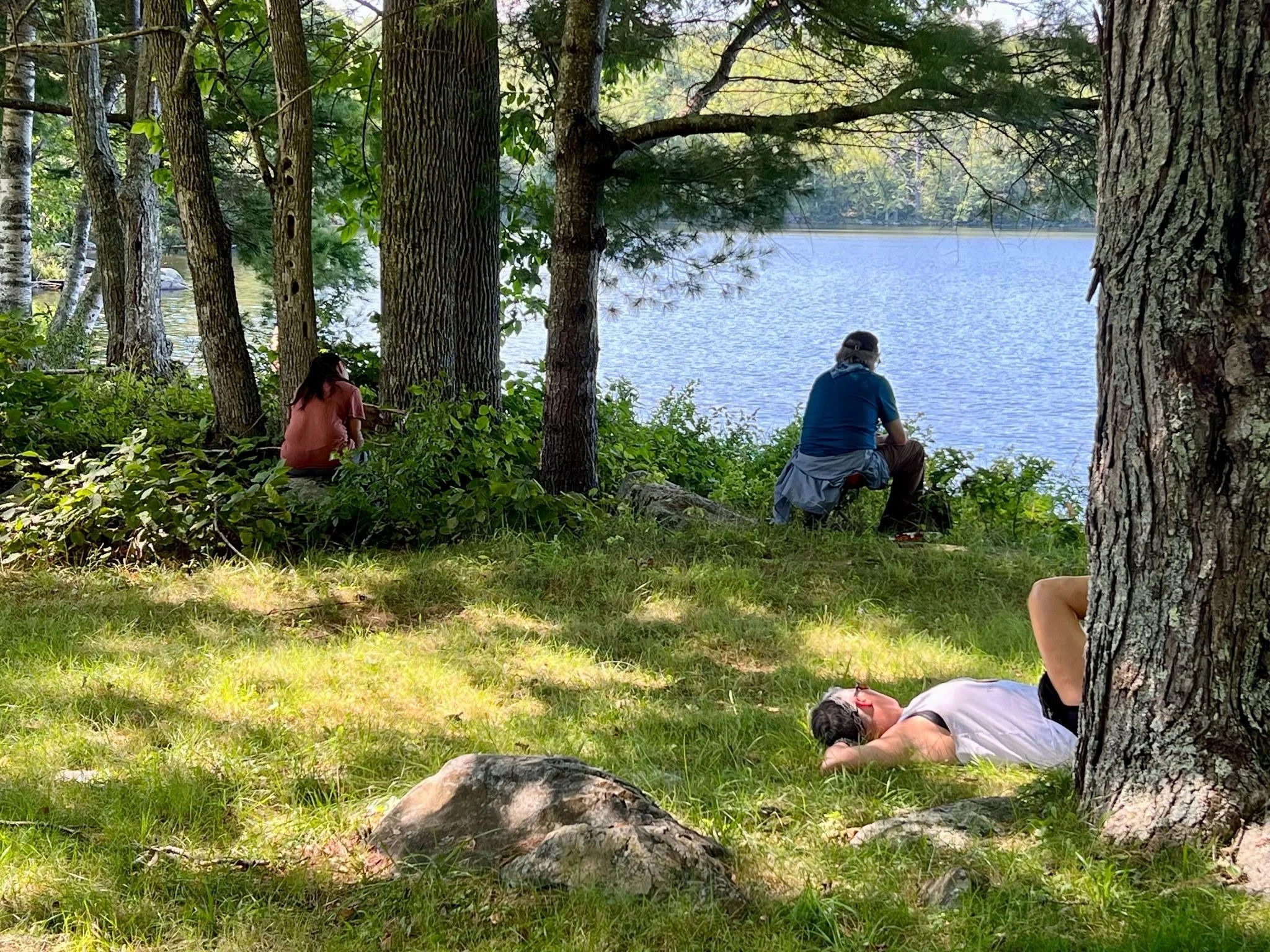
Forest bathing is the intentional practice of slowing down and soaking in the atmosphere of the forest through your senses. There is no water involved, unless you happen to wander beside a creek. We are bathing in sound, scent, color, texture, movement, and the felt presence of the life around us and our own body in relationship to the landscape.
The health benefits of forest bathing are now well researched. Studies point to lower cortisol, heart rate, and blood pressure, as well as improvements in mood, anxiety, and emotional well-being. Research has also begun to explore changes in attention, sleep, and immune activity.
And still, the numbers tell only part of the story.
At Heartwood School of Forest Therapy, we understand forest bathing as an embodied practice of relationship. We are not simply looking at Nature or using the forest to feel better. We are slowing down enough to receive the forest, notice how our bodies respond, and become part of a conversation that has been unfolding around us all along.
What Is Forest Bathing?
Forest bathing, or shinrin-yoku, translates loosely as “taking in” or “soaking in” the atmosphere of the forest. The Japanese Ministry of Agriculture, Forestry, and Fisheries introduced the term in 1982 to encourage people to spend time in forests for their health. Researchers later began measuring its effects, and the field of forest medicine emerged.
The modern name may be relatively new, but slowing down, listening to the land, and receiving guidance and nourishment from the more-than-human world are not new human activities. Indigenous peoples and land-connected cultures around the world have held sophisticated relationships with their local ecologies across generations. We can acknowledge the Japanese origins of shinrin-yoku while remembering that humans have always depended upon close attention to the natural world for food, medicine, shelter, navigation, meaning, and belonging.
In practice, forest bathing invites us to experience the natural world through our senses. We allow ourselves to linger and become curious about what we might notice when we give the landscape our full sensory attention.
Sight, sound, smell, touch, and sometimes taste are often the most familiar ways we experience a landscape during forest bathing. These senses help orient us to where we are and what is happening right now. From there, our awareness can begin to widen. We have far more than five senses, and these subtler ways of perceiving often support us in more deeply connecting with the wisdom of our own body and the wisdom of the landscape. Forest bathing allows us to explore these expanded senses that we might not be aware of while normally moving through a landscape.
Through forest bathing, we are soaking in the forest on many levels and inviting the outer landscape to create shifts within our inner one. Perhaps our breath becomes fuller. Our shoulders drop. We notice warmth, tingling, emotion, or simply more space inside ourselves. There is nothing we are required to feel. We are practicing listening.
How Is Forest Bathing Different From Hiking?
Most hikes have some forward momentum. A summit to reach, a trail to finish, or a certain number of miles to cover. Forest bathing invites us to slow down and to settle more down and in; there is no destination forward. The invitation is to be here now.
When we move quickly through Nature, we tend to receive broad strokes. We see the mountain, the lake, or the sweep of trees. We can miss the detail and the subtle expressions of the natural world: the cool slime trail of a snail, the earthy scent after a light rain, a delicate fern frond rising from the forest floor.
Forest bathing is a much slower practice. During two or three hours, we might travel less than a mile. We pause, wander, sit, listen, and follow what draws our attention. It is not about how far we travel, but how deeply we can settle into the landscape and ourselves.
Forest bathing can certainly feel meditative. At Heartwood, though, we hold it as an embodied and relational practice. We are not only observing what is happening. The body receives information from the forest and communicates in return. We notice the forest, and we begin to explore what it feels like to be noticed back by the forest.
My First Lesson in Forest Bathing
I experienced forest bathing long before I knew the term existed.
In 1996, I was a young researcher working in the rainforest of Panama. At that time, one of my nicknames was “Caffeine.” It rhymed with Kathleen, but it also captured my way of moving through the world. Slow was not my natural pace.
During my first encounters with the rainforest, I was so focused on collecting data, setting traps for parasitic wasps, and watching for snakes that I barely experienced the forest around me. Local people told me stories about the animals living within the canopy and along the forest floor, but I did not see them. My speed kept much of the rainforest hidden.
Then a Panamanian elder offered to help me see. For two hours, he taught me to move slowly, with intention and curiosity. We exchanged very few words. He guided me through his body, his eyes, and the way he listened. His love of the forest emanated through him.
As I slowed down, a new world appeared. I began to see the anteater, agouti, coati, and tapir that had been there all along. But the biggest change was in how I felt. A calm settled over me and stayed for days.
That experience taught me something I have carried ever since: when we change how we enter a landscape, we change what becomes available to us. The forest had not been withholding its treasures. I had been moving too quickly to receive them.
What Are the Health Benefits of Forest Bathing?
What I felt in Panama all those years ago has now been measured by scientists around the world. The clearest research points to short-term changes in the stress response, along with improvements in mood and well-being.
1. Stress hormones can decrease.
Cortisol is one of the body’s primary stress hormones. Because it can be measured through saliva or blood, researchers can compare levels before and after time in a forest. Forest bathing and nature exposure can decrease cortisol levels.
2. Heart rate and blood pressure can decrease.
Studies conducted in 24 forests across Japan found lower pulse rate, blood pressure, cortisol, and sympathetic nervous-system activity when participants spent time in forest environments rather than urban ones. Researchers also saw an increase in parasympathetic activity, which supports rest, digestion, and restoration.
3. Anxiety can ease, and mood can lift.
People often leave a forest bathing session feeling calmer, clearer, or a greater sense of vitality. Studies suggest decreases in anxiety, depressive symptoms, anger, fatigue, and confusion, along with an increase in vigor and positive mood.
A 2023 meta-analysis concluded that forest bathing may reduce symptoms of anxiety and depression. It does not mean forest bathing can replace psychotherapy, medication, or other mental-health care, but it may become a meaningful part of a larger circle of support.
4. The busy mind gets a different kind of rest.
Natural environments offer what researchers call “soft fascination.” Moving water, birdsong, clouds, branching patterns, and shifting light can hold our attention without asking us to concentrate or perform.
This gives the kind of attention we use for screens, decisions, work, and problem-solving a chance to rest. The mind does not have to become empty. We simply give it somewhere else to land: the swaying of trees, birds at a feeder, or the flow of water invite a softer, more restorative focus than screens.
5. The forest may support immune activity.
Trees release airborne organic compounds, including terpenes often referred to in forest bathing research as phytoncides. In early studies led by Dr. Qing Li, researchers found increased natural killer cell number and activity after participants spent extended time in forests. Natural killer cells are part of the immune system’s response to infected or abnormal cells.
But phytoncides are only part of the story. The mechanism of why Nature is so supportive is not clear, and most likely it is a synergistic effect: movement, cleaner air, reduced stress, sensory engagement, and we often sleep better afterwards. All of this supports our immune system as well as our mental health.
How Does Forest Bathing Work?
There is no single answer to this question. Is it the movement? The quiet? The forest air? The sensory input? The break from screens? The presence of a guide or community?
Most likely, it is the way all of these experiences work together.
Sensory experience and soft attention
The forest offers sound, scent, texture, color, pattern, depth, and movement without the concentrated demands of a screen or a busy human environment. Our senses give the mind somewhere to land besides the past, the future, and the familiar loop of our thoughts.
A slower, rhythmic pace
The pace itself matters. Slow walking, pausing, and resting offer a very different rhythm from the urgency many of us carry each day. Sometimes we do not realize how much internal buzziness has become our baseline until we experience the contrast of moving slowly through a forest.
I often think of forest bathing as a kind of spring cleaning. Nature supports us in clearing some of the internal clutter. We begin to remember what calm and spaciousness feel like in the body.
Autonomic nervous-system activity
Some forest bathing studies have found decreased sympathetic activity and increased parasympathetic activity. In other words, the body may begin to move out of a state of mobilization and toward rest, digestion, and restoration.
It's important to note that someone with a trauma history, experiences of racial violence outdoors, fear of wildlife, limited mobility, or another reason for feeling vulnerable may not immediately settle in a forest. What we can say is that the nervous system is receiving new information. How the body responds to that information will be different for each person.
Airborne compounds from trees
Phytoncides and other compounds released by trees may contribute to the physiological effects of forest exposure. They are one pathway, but certainly not the whole story.
Relationship and co-regulation
There is also the relational container. A grounded guide holds the pace, offers choices, and stays present to the group. The steadiness of the guide can support co-regulation between nervous systems, in collaboration with the landscape. This part of the experience has not been isolated well in research, yet those of us who guide see its importance again and again.
The landscape, sensory awareness, slower movement, less technological input, human connection, and the experience of belonging weave together to create the “magic” of forest bathing.
Is Forest Bathing Really Medicine?
Can we really call forest bathing medicine?
I believe we can, as long as we are clear about what we mean. Medicine is not limited to something we swallow. Nourishing food can be medicine. Movement can be medicine. Community, rest, and meaningful ritual can be medicine.
Forest bathing can create a noticeable state shift in the body and support health over time. In this sense, it can be understood as preventive or complementary medicine.
Complementary does not mean interchangeable. Forest bathing is not a replacement for medication, psychotherapy, or medical treatment, and current research does not establish that it is equivalent or superior to anti-anxiety medication. It does not need to be. Forest bathing offers its own form of support by creating the conditions for presence, sensory restoration, embodied awareness, and relationship with the living world.
What Happens During a Guided Forest Bathing Session?
A trained forest therapy guide helps create the container in which people can slow down, land more fully in their bodies, and become present to what is unfolding in the more-than-human world.
At Heartwood, we teach guides to do this through a training program that weaves best practices in trauma-informed facilitation, mindfulness, and somatic awareness, and is grounded in earth-based wisdom.
A guided forest bathing session may include:
Arriving and orienting to the landscape
Crossing a threshold that marks a shift into a slower pace
Awakening sensory awareness
Wandering or sitting with invitations or suggestions for deepening connection
Gathering periodically to witness and share
Closing with tea, gratitude, or another reciprocal practice
No two forest bathing sessions are alike. Each experience is shaped by the season, the landscape, the people gathered, and what is unfolding in that particular place and moment.
Does Forest Bathing Have to Happen in a Forest?
No. A mature forest offers extraordinary sensory richness, biodiversity, shelter, and airborne compounds, but wilderness does not have exclusive rights to Nature connection.
You can practice in a city park, botanical garden, arboretum, meadow, or even at the beach. If you are chronically ill or homebound, you might begin in a comfortable place beneath one tree, beside an open window, or near a bird feeder. The night sky, rain, wind, houseplants, and changing light across a room can all become places of relationship.
Forest bathing can also be adapted for many different bodies. A wheelchair-accessible path through an arboretum can allow for a deeply nourishing experience.
The intention to connect, to slow down, and just be is the foundation of a forest bathing session. And when we expand our concept of Nature to include the tree along a city sidewalk, weeds growing through a crack in the pavement, or the night sky overhead, our possibilities of connection with Nature become endless.
Can Forest Bathing Ever Feel Uncomfortable?
Yes. Sometimes our fast pace is doing more than keeping us productive. It may also be covering up anxiety, restlessness, grief, or tension below the surface. When we slow down, those feelings can rise.
This does not mean the practice is going wrong. It means we need to respond to what is actually happening. If inward attention feels activating, a guide might offer more opportunities to orient to the surrounding landscape rather than direct attention into the body. The rhythmic movement of the body mimicking the sway of trees can feel regulating, or even attentively watching for movement within the landscape.
How to Try Forest Bathing
You do not need special equipment, a perfect landscape, or hours of free time to begin. Start with what is available.
Choose a place where you can feel comfortable. A nearby park, garden, or patch of trees is enough. The key is that you feel safe enough to allow yourself to relax and not be on guard.
Give yourself spacious time. A guided session often lasts two to three hours, but even 20 intentional minutes can be settling.
Silence your phone. Keep it available for safety, but reduce unnecessary interruptions.
Let go of distance and destination. Move slowly or remain in one place.
Orient through your senses. Notice color, movement, texture, temperature, sound, and scent.
Follow what draws your attention. Let curiosity guide you. What being draws your attention? Go there and listen, touch, smell, or just be with them.
Perhaps notice what is happening in your inner landscape. What is shifting?
Close with gratitude or reciprocity. Offer thanks, pick up litter, or consider how you might care for the landscape you have become a part of.
Returning to Relationship
Many people first come to forest bathing because they are stressed or tired, because they know they feel better outside, or simply because they are looking for a little more peace. They may even arrive after reading an article like this one about the health benefits.
But something often happens when we slow down and spend time with the natural world in this way. The forest begins to become more than a place we go to feel better, and we start developing a relationship, a heart connection.
And perhaps through that relationship, we remember something we have always known: we are a part of the landscape. The clay of our bones, the air within our lungs, the water flowing through our bodies, and the life bursting forth in each cell are intrinsically woven with the more-than-human world. We are not separate. We belong. And this belonging is deep, tending to the human spirit.
Perhaps this is the deeper medicine of forest bathing.
Ready to Deepen Your Relationship With Nature?
At Heartwood School of Forest Therapy, we prepare guides to offer embodied, trauma-informed, and reciprocal forest therapy experiences. Our forest therapy guide certification is rooted in mindfulness, somatic awareness, Earth-based wisdom, and a profound trust in the intelligence of the living world.
Schedule a complimentary discovery call with one of our instructors. You can ask questions, learn more about our online and retreat certification pathways, and explore whether Heartwood feels like the right place for you to begin.